
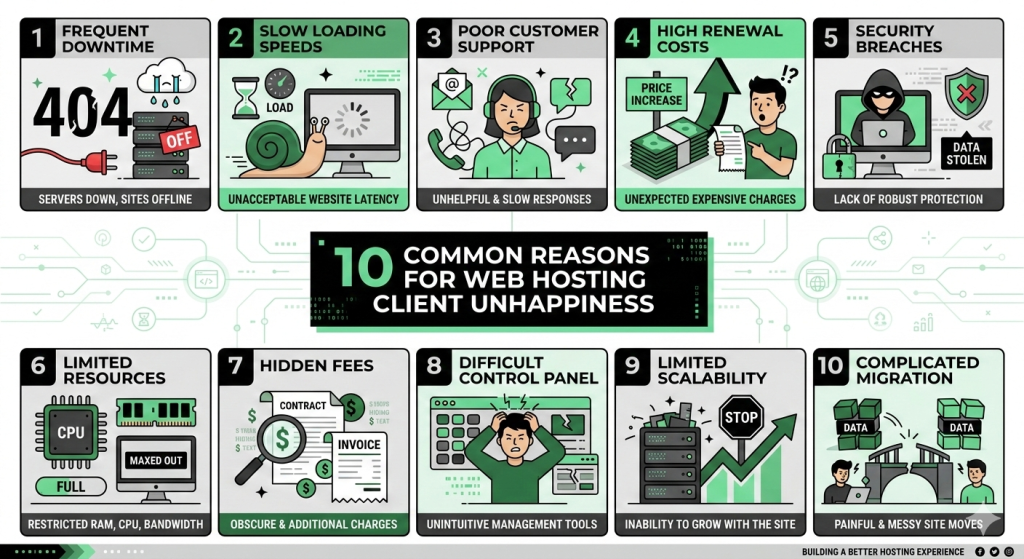

In the fast-paced digital economy of 2026, a website is often a business’s most valuable asset. However, the foundation of that asset—the web hosting provider—is frequently the primary source of professional frustration. As hosting technology evolves with AI-driven management and edge computing, client expectations have skyrocketed. When these expectations aren’t met, the result is “churn,” where unhappy clients migrate to competitors in search of reliability.
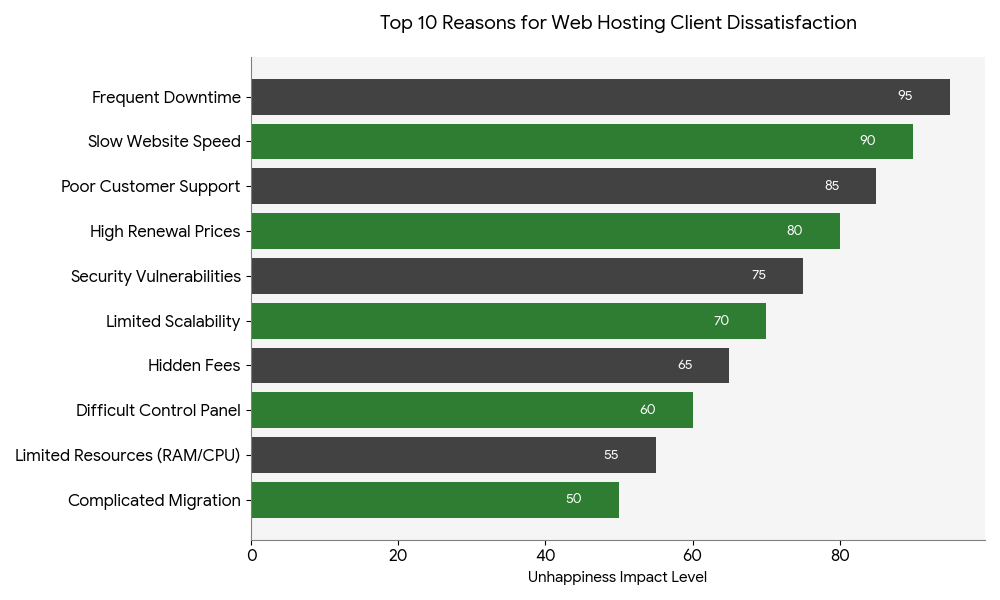
The graphical representation below outlines the top 10 reasons why a web hosting client might become unhappy with their existing service. The chart uses a professional palette of Black, Green, Grey, and White to highlight the impact of various service failures.
Here are the 10 most common reasons why web hosting clients become unhappy with their existing services in today’s market.
- Frequent and Unpredictable Downtime
Uptime is the “north star” of web hosting. In 2026, even the industry standard of 99.9% is often viewed as insufficient by high-traffic enterprises, as it still allows for nearly nine hours of downtime per year. When a server goes dark, the client loses more than just visibility; they lose revenue, ad spend efficiency, and search engine rankings. For an e-commerce site, a single hour of downtime during a peak period can equate to thousands of dollars in lost sales and a permanent dent in customer trust.
- Sluggish Loading Speeds
With Google’s Core Web Vitals now being a dominant ranking factor, speed is no longer a luxury. Modern users expect pages to load in under two seconds. If a hosting provider overloads its shared servers or uses outdated hardware, the resulting latency leads to high “bounce rates.” Clients become understandably frustrated when they invest heavily in web design and SEO, only to have their efforts neutralized by a slow server response time (TTFB).
- Declining Quality of Customer Support
A major trend in 2026 is the “AI-first” support model. While AI bots can handle basic queries, many clients feel abandoned when they face complex technical crises and are trapped in a loop of unhelpful automated responses. The “human touch” has become a premium feature. Clients grow unhappy when they encounter Tier-1 agents who lack deep technical knowledge or when “24/7 support” turns out to mean “24/7 ticket submissions with 48-hour response times.”
- Aggressive “Bait-and-Switch” Pricing
The hosting industry is notorious for introductory rates that look like bargains but quintuple upon renewal. In 2026, price transparency is a major driver of loyalty. Clients feel “trapped” when they realize the $5/month plan they signed up for jumps to $25/month after the first year. These hidden “renewal hikes” are a leading cause of client resentment and a primary catalyst for migration to providers with flat-rate pricing models.
- Security Vulnerabilities and Poor Backups
As AI-powered cyberattacks become more sophisticated, security is a non-negotiable requirement. Clients expect their hosts to provide robust firewalls, DDoS protection, and automated malware scanning. Dissatisfaction peaks when a site is hacked due to server-level vulnerabilities, or worse, when a client discovers that the “automated backups” they were promised were either non-existent or corrupted when they needed them most.
- Resource Throttling and Limits
Shared hosting environments often come with “unlimited” promises that are anything but. Providers frequently use CPU and RAM throttling to manage server load. A client whose business starts to gain traction may suddenly find their site suspended or slowed to a crawl because they exceeded an obscure “inode” limit or used too much processing power. This “success penalty” makes clients feel that their host is an obstacle to their growth rather than a partner.
- Difficult and Outdated Control Panels
The user experience (UX) of the hosting dashboard matters. While industry staples like cPanel remain popular, many modern clients prefer intuitive, custom-built interfaces (like hPanel or SPanel). A cluttered, difficult-to-navigate backend that makes simple tasks—like creating an email account or installing an SSL certificate—feel like a chore will quickly wear down a client’s patience.
- Hidden Fees for Basic Features
In an era where “Value for Money” is the top priority for 80% of users, getting “nickeled and dimed” is a major grievance. Some hosts charge extra for essential features like SSL certificates, professional email addresses, or site migrations. When a “budget” host adds $100 in add-ons to a $50 plan, the perceived value evaporates, leaving the client feeling misled by the initial marketing.
- Limited Scalability Options
The transition from a small blog to a high-traffic store should be seamless. However, many traditional hosts make the jump from shared hosting to a VPS or Dedicated Server a technical nightmare. If a host cannot offer “one-click” scaling or flexible cloud resources that grow with the site, the client will eventually outgrow the provider and look for a more elastic solution.
- Complicated “Hostage” Situations (Migration Barriers)
Finally, nothing breeds more unhappiness than a host that makes it difficult to leave. This includes complex cancellation processes, refusing to provide full site backups, or charging exorbitant fees for migration assistance. When a client feels they are being held “hostage” by technical barriers, their likelihood of leaving a negative review increases exponentially, damaging the provider’s reputation in the long run.
Conclusion
The common thread in all these complaints is a gap between promise and performance. In 2026, web hosting is no longer just a utility; it is a strategic partnership. Providers that prioritize transparency, consistent performance, and empathetic support are the ones who will thrive, while those relying on legacy tactics of hidden fees and poor infrastructure will continue to see their client base dwindle.
